Carbon Road Bike Buying Guide: Choose the Right Ride
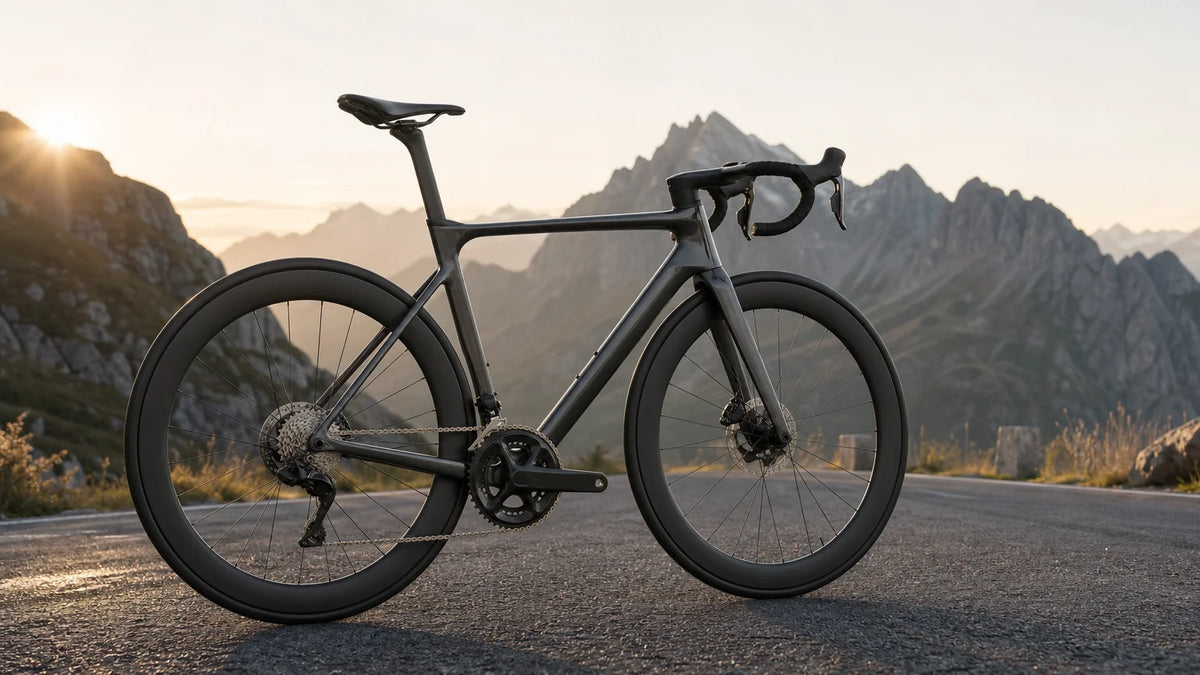
A carbon road bike can be exceptionally light, responsive, aerodynamic, and visually refined. However, the right purchase depends on much more than the word carbon on the frame. Your daily routes, preferred pace, body position, maintenance expectations, and design priorities should all influence the decision. If distinctive design matters alongside performance, our Cyclik road bike illustrates how a bicycle can become part of a wider mobility collection.
The market is also broadening across price levels and riding styles. One 2026 market estimate placed the global carbon fiber bike market at $2.04 billion, up from an estimated $1.88 billion in 2025, according to a 2026 market estimate. That growth does not make every carbon bike suitable for every rider. It makes a clear buying method more valuable.
What should your carbon road bike do for you?
Imagine two riders choosing from the same showroom. One trains for fast group rides and local races. The other wants comfortable weekend rides, long climbs, and occasional stretches of rough pavement. Both may benefit from carbon, but they should not choose the same bicycle.
Start by defining your riding purpose. A race-focused carbon road bike generally emphasizes an efficient position, quick handling, aerodynamic tube shapes, and firm power transfer. It can feel lively when you accelerate, corner, or climb. The trade-off is that a low front end and responsive steering may demand more flexibility, concentration, and adaptation from the rider.
An endurance road bike places greater emphasis on stability, comfort, and distance. Its taller front end and slightly shorter reach can reduce pressure on your hands, shoulders, and lower back. It may also provide more clearance for wider tires, which can improve grip and comfort on imperfect pavement.
An all-road model sits between a conventional road bike and a gravel bike. It can suit riders who spend most of their time on asphalt but occasionally use hard-packed paths or poorly surfaced lanes. If you expect regular rough gravel, bikepacking, or loaded touring, a gravel or touring platform may be more appropriate than a highly optimized road race frame.
- Race riding: prioritize efficient geometry, precise handling, aerodynamic integration, and responsive acceleration.
- Long-distance riding: prioritize stable geometry, suitable tire clearance, comfortable contact points, and practical gearing.
- Mixed surfaces: prioritize clearance, lower gearing, confident handling, and compatibility with accessories.
- Recreational riding: prioritize fit, reliability, serviceability, and a position you can hold comfortably.
Your future use matters as much as your current use. If you are beginning road cycling, versatility can be more valuable than a specialized race setup. A carbon endurance bike can still feel fast, while a race bike can still cover long distances. The key difference is how comfortably and confidently you can use it for several hours.
Should you choose race or endurance geometry?
Question the position before you compare component levels. Geometry determines how the bike supports your body, how quickly it responds to steering input, and how relaxed you feel after several hours.
Race geometry typically combines a lower stack, longer reach, shorter wheelbase, and sharper steering response. This arrangement can improve aerodynamics and make the bike feel immediate under hard efforts. It can also increase pressure on the neck, wrists, and shoulders if the position does not suit your flexibility or riding habits.
Endurance geometry usually raises the handlebar position and creates a more stable relationship between the wheels. The longer wheelbase can make the bike feel calmer on descents and uneven roads. This does not mean the bike is slow. It means the design gives greater priority to control and sustainable comfort.
Aero race bikes add deeper frame sections, integrated cockpits, and deeper wheels. These features may help reduce aerodynamic drag at higher speeds, particularly when riding into a headwind or maintaining a fast group pace. They can also increase cost, complicate adjustments, and make replacement parts more specific.
Lightweight race bikes take a different approach. They often use more compact tube profiles and lighter components to reduce mass for climbing and acceleration. An all-round race bike attempts to balance these characteristics, which can be a sensible choice when your routes include flats, hills, fast descents, and competitive group rides.
Do not select geometry solely because it appears in professional racing. Professional riders often use aggressive positions, receive regular support, and spend much of their time adapting equipment to precise performance goals. For most private riders, the most effective geometry is the one that allows consistent training, relaxed control, and fewer physical distractions.
How does carbon construction affect the ride?
Two carbon frames can look similar and ride very differently. The difference may come from the fiber grades, layup schedule, tube shapes, resin system, manufacturing precision, and the way the frame balances stiffness with compliance.
Carbon layup allows designers to tune different areas of the frame. The bottom bracket region may be reinforced for power transfer, while the seatstays, fork, and seatpost may be designed to filter vibration. A lighter frame is not automatically more comfortable, and a stiffer frame is not automatically faster for every rider or route.
Pay attention to the complete bicycle rather than the frame claim. A premium carbon frame fitted with heavy wheels and basic tires may feel less lively than a well-balanced bicycle with a slightly heavier frame and better wheels. The fork, cockpit, seatpost, saddle, and tire pressure all affect the ride beneath you.
Carbon also requires sensible handling. It is strong when designed and used correctly, but impact damage can be less visible than a dent in an aluminum frame. Never tighten a carbon component beyond the manufacturer’s torque specification. Inspect the frame after a crash, transport incident, or significant impact, especially around the head tube, bottom bracket, seat cluster, chainstays, and fork.
Independent testing can help place marketing language in context. In 2026, Cyclingnews testing emphasized that stiffness is not a simple measure where more is always better. The useful question is how stiffness, compliance, weight, handling, and fit combine for your body and your route.
If your purchase also involves design, rarity, and a clear visual identity, our Viks Carbon bike offers a useful reminder that a bicycle can be evaluated as both a technical object and a piece of contemporary mobility design. The same principle applies to any model you consider. Examine the engineering, then ask whether the object motivates you to ride.

Which drivetrain, brakes, wheels, and tires matter most?
Consider a ride that begins with a climb, continues through rolling roads, and finishes on wet pavement. The quality of the complete system becomes more important than any single component name.
The groupset includes the shifters, derailleurs, crankset, chain, cassette, and braking components. Higher levels generally reduce weight and provide more refined shifting, but the practical difference between modern mid-range and flagship equipment may be smaller than the price difference.
Electronic shifting provides consistent gear changes and can be convenient when you frequently shift under pressure. It adds batteries, charging requirements, and potentially higher replacement costs. Mechanical shifting remains straightforward to inspect and service, making it appealing for riders who value simplicity or travel frequently.
A two-chainring drivetrain gives you closely spaced gears and a broad overall range. It is well suited to road riding where you want precise cadence control on both climbs and fast sections. A one-chainring drivetrain simplifies the system and can work well for mixed terrain, but its gear steps may be more noticeable on paved roads.
Disc brakes are now common on new performance road bikes. Hydraulic disc systems provide strong modulation and consistent braking in wet conditions. They also support wider tire clearances in many frame designs. Rim brakes can be lighter and easier to service, but their performance may be more affected by rain and worn braking surfaces.
Wheels often create a larger change in feel than buyers expect. A lighter wheelset can improve acceleration, while deeper rims may provide aerodynamic benefits on fast, exposed roads. Wheel depth should match your environment. Very deep rims can be more difficult to manage in strong crosswinds, especially for lighter riders.
Tires connect every other component to the road. Wider tires can improve comfort and grip when used with suitable rims and pressures. Before choosing 30 millimeter or 32 millimeter tires, confirm the frame and fork clearance, the rim compatibility, and the manufacturer’s recommended limits. Never assume that a tire will fit because its labeled width appears modest.
Tubeless systems can reduce pinch-flat risk and allow lower pressures, but they require sealant checks, compatible rims, and a plan for roadside repairs. Inner tubes remain practical and easy to understand. The best system is the one you can maintain confidently and repair when you are away from home.
How do you get the correct size and fit?
What is the value of an advanced frame if its reach and handlebar position do not suit your body? Fit should be settled before you spend more on wheels, electronic shifting, or an integrated cockpit.
Begin with the manufacturer’s size chart, then review the geometry table. Stack and reach are particularly useful because they describe the position of the front of the frame more consistently than a nominal size such as 54 or 56 centimeters. Two bicycles with the same labeled size can produce noticeably different riding positions.
Measure your height and inseam carefully, but do not treat those measurements as a final answer. Torso length, arm length, flexibility, riding experience, and preferred posture can all influence the correct size. Riders near the boundary between sizes should consider professional guidance rather than selecting based only on price or availability.
Several adjustments can refine a suitable frame. The stem length affects reach and steering response. Handlebar width affects comfort and control. Saddle height, setback, and tilt influence leg extension and pressure distribution. These changes are useful, but they cannot fully correct a frame that is fundamentally too long, too short, too high, or too low.
Integrated cockpits can look clean and improve cable management, yet they may limit adjustment and make replacement parts more specific. If you are still learning your preferred position, a conventional stem and handlebar arrangement may provide more flexibility. This is especially relevant when buying online or purchasing internationally.
After the first few rides, assess your body rather than judging only the bicycle. Persistent numbness, knee discomfort, lower-back fatigue, or hand pressure may indicate a fit problem. A professional fitting can help distinguish between setup issues and a frame that does not suit your proportions.

How should you plan your budget and ownership costs?
A $3,000 bicycle and a $10,000 bicycle can both provide enjoyable road riding. The difference is often found in weight, finishing quality, wheel performance, integration, materials, and component refinement, rather than in a completely different riding experience.
Set a complete budget that includes pedals, shoes, helmet, lights, bottles, tools, transport, insurance where relevant, and future maintenance. A bicycle that consumes the entire budget may leave you without the equipment needed to use it safely and comfortably.
- Entry-level carbon: may provide the material benefits of carbon, but components and wheels can be heavier.
- Mid-range carbon: often balances frame quality, reliable groupsets, hydraulic brakes, and useful wheel upgrades.
- Premium carbon: may add lower weight, integrated systems, high-end wheels, electronic shifting, and more specialized finishing.
- Custom or boutique builds: can offer distinctive design, tailored specifications, and a stronger sense of ownership, but service and replacement parts require careful planning.
Do not sacrifice fit for a better drivetrain. Do not buy a fragile wheelset if your roads are rough and your local service options are limited. Do not choose a highly integrated bicycle if you regularly travel to regions where compatible parts are difficult to obtain.
The 2026 market includes endurance bikes, race bikes, aero designs, lightweight builds, and models that bridge into all-road use. A 2026 road roundup illustrates this range across different riding categories and price levels. The practical lesson is simple: compare the purpose of each bicycle before comparing its component hierarchy.
What should you inspect before buying a carbon road bike?
Before you place an order, create a short inspection and ownership checklist. This is essential when buying used, importing a bicycle, ordering a frameset, or purchasing a machine with specialized parts.
Inspect the frame under strong, even lighting. Look for cracks, sharp impact marks, exposed fibers, unusual dull areas, and damage near high-stress junctions. A superficial paint mark is not automatically structural damage, but any uncertainty deserves professional evaluation before riding.
Check the drivetrain for worn chainrings, cassette teeth, chain stretch, noisy bearings, and inconsistent shifting. Spin both wheels and watch for lateral movement or vertical hops. Test the headset, bottom bracket, and wheel bearings for play or grinding.
Confirm that the serial number, purchase documentation, warranty terms, and service history are available. For international purchases, clarify taxes, import duties, delivery arrangements, assembly requirements, and who handles warranty support in your country.
Ask whether the frame accepts the tires, mudguards, racks, or storage accessories you expect to use. Confirm the brake standard, axle dimensions, freehub body, seatpost design, headset parts, and electronic battery system. A bicycle can be technically excellent yet inconvenient if routine replacement parts are difficult to source.
Finally, think about emotional value. A road bike is equipment, but it is also something you will see, maintain, transport, and ride repeatedly. Our bicycle collection reflects how mobility objects can combine engineering, visual character, and a sense of discovery. Your final choice should meet practical requirements while remaining an object you genuinely want to use.
Choose the carbon road bike you will actually ride
The right carbon road bike is not defined by the lightest frame, the most expensive groupset, or the most aggressive geometry. It is the bicycle that matches your roads, your body, your maintenance habits, and your ambitions. Begin with riding purpose, confirm the fit, assess the complete build, and reserve part of your budget for ownership costs. When performance and design support the same goal, your purchase is more likely to remain satisfying for many seasons.
Take action with TheArsenale
Once you understand the differences between race geometry, endurance comfort, carbon construction, and component levels, the next step is to compare objects that reflect your priorities. A curated mobility marketplace can help you consider a bicycle not only as transport, but also as an expression of engineering, design, and personal taste.

We bring together distinctive mobility objects for collectors and enthusiasts seeking a more considered purchase journey. To continue exploring a curated selection of road bike options, contact our team through TheArsenale and discuss the characteristics, availability, and acquisition path relevant to your needs.
Frequently Asked Questions
Is carbon always better than aluminum for a road bike?
Carbon can provide low weight, tuned stiffness, aerodynamic shaping, and vibration control. A well-designed aluminum bicycle may still offer better value, simpler ownership, or more suitable components for your budget and riding conditions.
Should you choose a race bike or an endurance bike?
Choose a race bike if speed, aggressive positioning, and responsive handling are your main priorities. Choose an endurance bike if you value long-distance comfort, stability, and a more adaptable position.
How wide should your road bike tires be?
Many riders benefit from tires wider than traditional narrow road tires, particularly on imperfect pavement. Check the frame, fork, rim, and brake clearance before selecting a wider size.
Is electronic shifting worth the additional cost?
Electronic shifting offers precise, consistent gear changes and convenient adjustment. Mechanical shifting can be easier to maintain and may allow you to invest more of your budget in fit, wheels, tires, or a higher-quality frame.
Can TheArsenale help with a distinctive bicycle purchase?
Yes, our curated bicycle and mobility offer is designed for collectors and enthusiasts interested in unusual, design-led objects. You can contact our team to discuss available products, sourcing questions, and the most suitable acquisition route.