Wooden Toy Car for Sale: A Guide to Quality and Design
What makes a small toy car worth keeping long after the first play session? A thoughtful wooden toy car for sale should feel satisfying in the hand, move reliably, and support imaginative play without unnecessary mechanisms. For a refined starting point, explore our designer wooden toys and consider how craftsmanship influences both play value and display appeal.
The right choice depends on more than color or price. You should assess the wood, finish, moving parts, recommended age, construction quality, and the seller’s transparency. A well-chosen car can become a daily play object, a nursery accent, or a design-led gift that remains relevant as a child’s interests develop.
What should you check before buying?
Begin with the materials and construction. Look for clearly stated wood types, a smooth surface, securely fitted wheels, and a finish described by the maker. If a seller mentions a water-based or non-toxic finish, treat that information as useful only when it is supported by clear product details and appropriate age guidance.
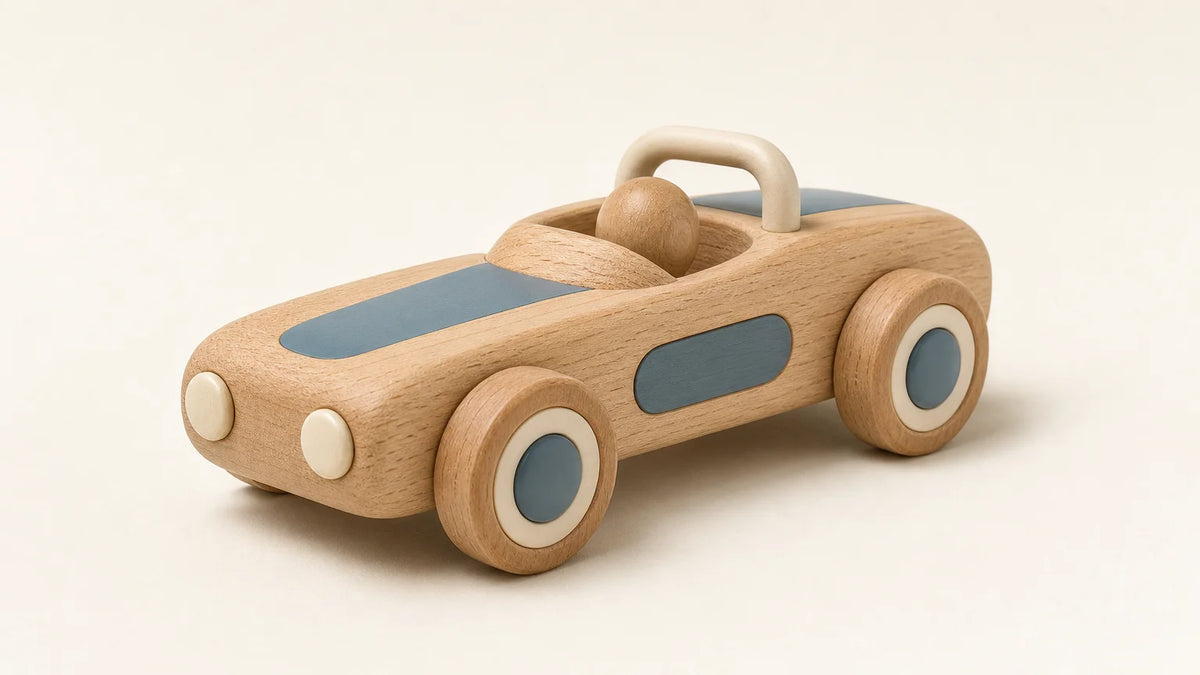
Solid wood construction can provide a reassuring weight and tactile feel, but material alone does not determine quality. Inspect photographs for rough edges, cracks, loose axles, uneven paint, or decorative parts that appear easy to detach. A simple form with fewer components is often easier to evaluate than a highly detailed car with many small additions.
Scale also matters. A compact push car may suit small hands, while a larger model may work better for floor play or display. Consider where the toy will be used, whether the wheels roll smoothly on that surface, and whether the proportions are comfortable for the intended child.
Why does toy safety matter more than appearance?
Attractive styling should never replace basic safety information. A 2024 BTHA marketplace report documented unsafe toy listings in its sample, including products associated with choking hazards. The finding does not mean that every online listing is unsafe, but it shows why product descriptions and seller accountability deserve careful attention.
Pay particular attention to the wheels and axles. In its 2018 safety report, the W.A.T.C.H. report discussed a wooden toy car recalled because its wheels could detach and create a choking hazard. This historical example remains relevant because detachable parts are difficult to identify from a polished product photograph alone.
Check the recommended age, testing references, manufacturer identity, and return information before purchasing. Avoid relying on vague phrases such as “safe for all ages” when the listing does not explain why. If the car is intended for a toddler, choose a robust design with no loose accessories and supervise play according to the manufacturer’s guidance.

Which style suits the child and the room?
A classic push car is usually the most versatile option. Its open-ended format lets children invent journeys, races, garages, rescue scenes, or imaginary cities without requiring batteries or a fixed storyline. This simplicity supports screen-free play and makes the car easy to combine with blocks, figures, roads, and other vehicles.
Vehicle sets provide more narrative possibilities, especially when they include different shapes or roles. A taxi, bus, emergency vehicle, or delivery van can encourage children to create social situations and explain how their imagined world works. However, a set is not automatically better than one carefully made car. Choose the format that matches the child’s attention span, available storage, and existing toys.
For a coordinated play space, our toys for kids can help you consider vehicles alongside other design-led objects. The most successful choice usually balances visual character with practical playability. A distinctive silhouette can attract attention, while a restrained palette may fit more naturally into a shared living area or nursery.
How should you compare listings and prices?
Price should be considered alongside materials, scale, construction, and after-sales information. A low-cost car may be suitable for casual play, but it may provide less detail about the wood, finish, testing, or replacement support. A higher price can reflect hand-finishing, a limited design, better packaging, or a recognized maker, although none of these factors should be assumed without evidence.
Online marketplaces often combine new, used, handmade, branded, and unbranded products in the same search. In a September 2026 snapshot, an eBay category snapshot displayed 6,438 results with separate filters for condition and age. This variety can be useful, but it also makes direct price comparisons unreliable.
Before you buy, compare like with like. Check whether the price covers one car or a set, whether shipping is included, whether the product is in stock, and whether the photographs show the actual item. For used toys, ask about chips, fading, repairs, missing parts, and storage conditions. For handmade products, confirm dimensions and expected variations before ordering.
When is a designer toy car the better choice?
A designer toy car may be appropriate when the gift needs to do more than provide short-term entertainment. These pieces often place greater emphasis on proportion, materials, color, and visual identity. They can serve as collectible-inspired design objects while remaining accessible for imaginative play.
This does not mean that every child needs a collectible. Younger children may benefit more from a simple, durable vehicle that can withstand frequent handling. Older children, design-conscious families, and collectors may value a more distinctive object that connects play with automotive culture and interior design.
Our editorial selection of design toys for kids can help frame that decision around craftsmanship, originality, and long-term appeal. The important question is whether the object feels appropriate for the recipient. A refined toy should remain inviting, not become so delicate that it is treated only as decoration.
What is a practical buying checklist?
Before placing an order, review the listing with a short checklist. This process helps you separate genuine quality from attractive photography or vague marketing language.
- Material clarity: Confirm the type of wood or other primary material.
- Finish information: Look for details about paint, oils, stains, and surface treatment.
- Age guidance: Match the product recommendation to the child’s development and play habits.
- Wheel security: Check that wheels and axles are integrated firmly and do not appear loose.
- Dimensions: Compare the measurements with the child’s hands, play surface, and storage space.
- Seller transparency: Look for a clear manufacturer, product description, contact route, and returns policy.
- Use case: Decide whether you want a daily plaything, a gift, a set, or a display-oriented object.
If you are buying internationally, also check delivery times, taxes, import charges, and the seller’s approach to damaged items. These details can affect the final cost and the practicality of the purchase. A carefully documented listing is usually easier to trust than one that relies only on lifestyle images.
Choose for play, quality, and lasting appeal
The best wooden toy car is not necessarily the least expensive or the most elaborate. It is the one that combines secure construction, suitable proportions, clear age guidance, and a design that encourages repeated use. Compare the practical details first, then decide whether a classic push car, a vehicle set, or a designer object best matches the recipient. When quality and character support one another, the toy can become both an engaging play object and a lasting part of the home.
Take action with TheArsenale
If you are looking beyond an ordinary toy vehicle, your choice can reflect a deeper interest in automotive design, proportion, and the culture of mobility. TheArsenale brings a curated perspective to objects connected with extraordinary machines and future-oriented design.

Explore the Bugatti Baby II toy car when you want a distinctive object with a strong connection to automotive design. It offers a considered alternative to mass-market toy vehicles and can suit collectors, design-conscious families, and enthusiasts seeking a more memorable gift.
Frequently Asked Questions
What age is suitable for a wooden toy car?
The suitable age depends on the product’s design, dimensions, and manufacturer guidance. Choose a model without detachable small parts for younger children, and supervise play whenever the product instructions recommend it.
Are wooden toy cars better than plastic toy cars?
Neither material is automatically better for every child. Wooden cars can offer a tactile feel and a simple, durable form, while plastic models may provide lighter weight, complex features, or easier cleaning.
What should I look for in a safe wooden toy car?
Look for secure wheels, smooth edges, clear age guidance, reliable seller information, and transparent details about finishes. Avoid products with loose parts, unexplained materials, or vague safety claims.
Can a wooden toy car also be used as decoration?
Yes, many well-designed cars can work as both play objects and display pieces. Choose a durable model with a balanced shape and a finish that suits the room, but do not sacrifice playability for appearance.
Does TheArsenale sell designer toy cars?
Yes, TheArsenale presents curated design-led toys and mobility-inspired objects for children and collectors. Its selection can suit buyers who want a toy with stronger visual identity and a closer connection to automotive culture.